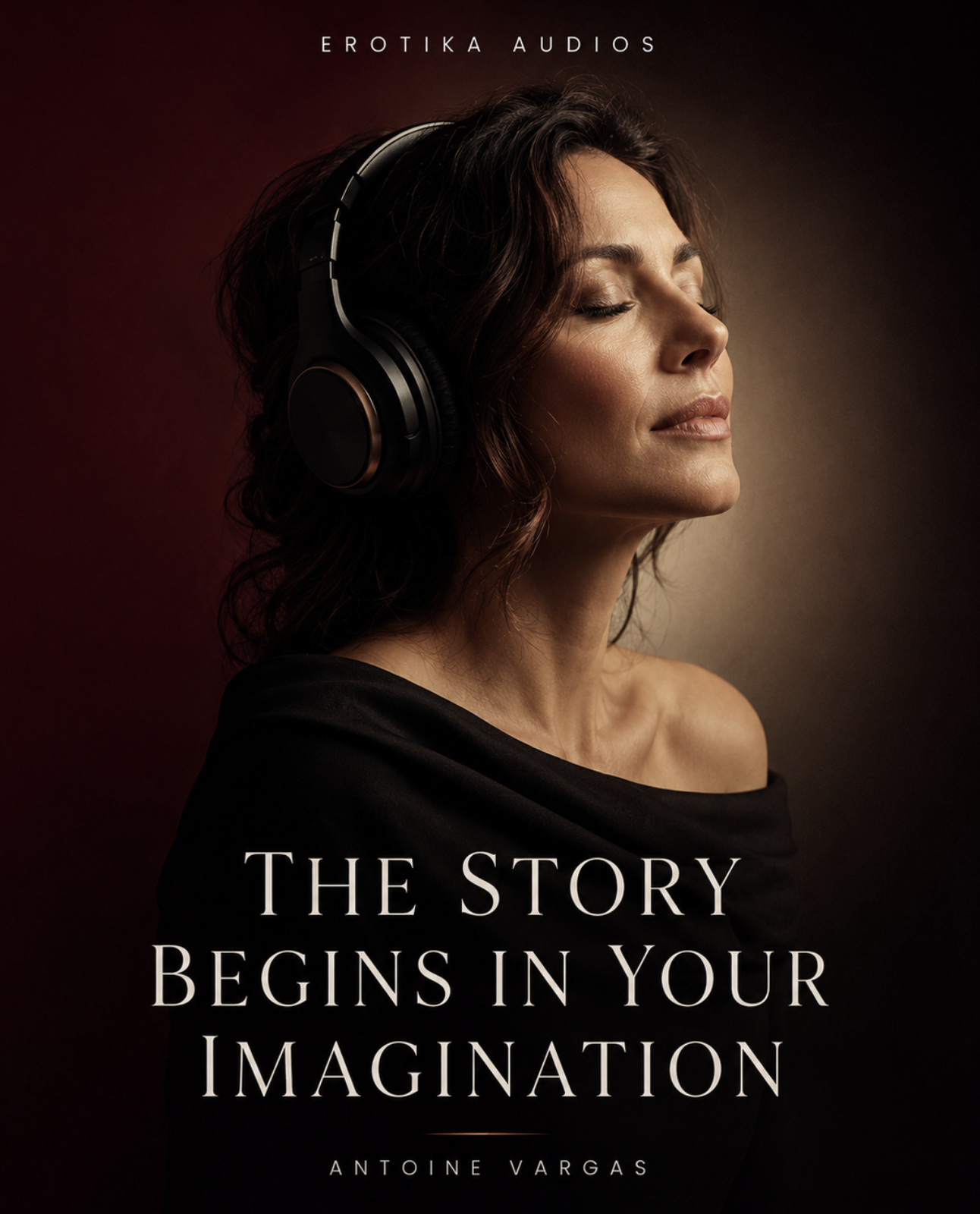
There is a curious intimacy in listening to a story with your eyes closed. Nothing appears on a screen, yet a room begins to take shape. You sense its light, its temperature and the distance between two people. A character may have no visible face, but your mind quietly gives that person an expression, a history and perhaps even a familiar gesture.
That is not an absence of imagery. It is an invitation to create it.
Sensual audio occupies a particular space between literature, performance and private imagination. It can suggest without exposing, guide without controlling and create emotional tension without showing everything. For listeners who prefer atmosphere and psychology to spectacle, this incompleteness is not a limitation. It is part of the pleasure.
The listener becomes a discreet co-author
A visual production makes hundreds of decisions before the audience arrives: the actors’ faces, the room, the clothes, the lighting and exactly where each person stands. Audio makes fewer decisions. It offers a voice, words, rhythm, perhaps music—and leaves meaningful spaces unfinished.
The listener fills those spaces with personal material. The apartment may resemble one she once knew. A laugh may recall someone. A moment of hesitation may feel more revealing than a long description. No two listeners necessarily construct the same scene, even when they hear precisely the same recording.
Imagination can intensify emotion
Research on mental imagery offers a useful clue, although the studies were not tests of ErotiKa or erotic audio specifically. In controlled experiments, mental imagery has often produced stronger emotional responses than verbal thinking about the same material. Research by Mathews and colleagues found that imagined scenarios were rated as more emotional and more realistic than scenarios processed verbally.
Another study asked participants to listen to brief emotional scripts and imagine themselves inside the events. Brain activity differed for emotionally arousing narratives and neutral ones. This does not mean that audio automatically creates intimacy; it suggests that narrative listening can help the mind simulate an experience.
Voice carries what the page cannot
Written fiction lets the reader choose the pace. Audio adds human timing. A sentence can become warmer when spoken softly. A pause can create uncertainty. A breath can suggest that a character is deciding whether to continue.
The most effective sensual narration does not need to be loud or explicit. Often, restraint creates greater attention. Silence becomes part of the sentence.
A private experience—alone or together
Headphones create a personal listening space. Yet the same format can also be shared by a couple. Listening together offers a gentle way to discover what creates curiosity: the setting, the emotional dynamic, the anticipation or the particular way desire is expressed.
The story becomes a third space. Neither partner has to begin with a direct confession. They can simply ask: “Which part stayed with you?” A fantasy heard together does not have to become a plan. It can remain a story, a conversation or a new way of understanding one another.
The image you create belongs to you
Sensual audio works because it trusts the listener to participate. The unseen room is not empty. The unpictured face is not missing. Both are waiting to be imagined.
Perhaps that is why an audio story can feel so personal: part of it comes from the author, part from the voice, and part from a place no one else can see.
Sources and research notes
- Mathews et al. (2013), mental imagery, realism and emotion.
- Pearson et al. (2015), mental imagery, perception and emotion.
- Sabatinelli et al. (2006), the neural basis of narrative imagery.
Sexual-health information is educational and does not replace individualized medical advice.